 Deutsch
 English
 Français
Deutsche Telekom: a digitally sovereign European eSigning platform as an alternative to DocuSign
Magenta Security Sign: privacy-first eSigning under the Deutsche Telekom brand
- Deutsche Telekom’s signature solution, available to all Group companies through a Group licence
- On the market since November 2025 and available via the Telekom Cloud Marketplace
- QES at a flat rate with the Telekom Qualified.ID signature card
- Operated in Germany, within Deutsche Telekom’s infrastructure and Trust Center
Meet the customer
Deutsche Telekom is one of Europe’s leading telecommunications and IT companies. With a broad portfolio of telecommunications, cloud, IT and cybersecurity solutions, it helps businesses and public-sector organisations run their business processes securely and digitally.
At a glance
Electronic signatures have become an integral part of everyday business. But the more sensitive documents and data become, the more important it is to know where they are processed and who has access to them.
Deutsche Telekom faced exactly this challenge. Until then, the company had relied on DocuSign, which as a US company is subject to the US CLOUD Act1. As a result, internal guidelines did not allow certain particularly sensitive documents to be signed electronically with it at all. For Deutsche Telekom, this made one thing clear: a long-term eSigning strategy must do more than deliver legally valid electronic signatures. It must also ensure digital sovereignty and control over the company’s own sensitive data.
1 The US CLOUD Act can require US companies to give US authorities access to data, even if that data is stored in Europe.

Industry
Telecommunications & IT

White-label solution
Magenta Security Sign

Target group
Businesses and public-sector organisations
The challenge
With growing requirements for data protection, digital sovereignty and regulatory compliance, Deutsche Telekom reviewed its existing eSigning strategy. It was looking for a solution that would not only meet its own high standards but also give business customers a secure European alternative to US solutions.
Alongside data protection and compliance, the focus was above all on digital sovereignty and control over sensitive company data. At the same time, the solution had to integrate fully into the existing Telekom portfolio and run under Deutsche Telekom’s own control on the Open Telekom Cloud. The key requirements were:
- A digitally sovereign European alternative to US solutions
- Privacy-first eSigning as a core principle
- The highest data protection and security standards
- GDPR-compliant, eIDAS- and ZertES-compliant electronic signatures (SES, AES & QES)
- Zero Document Knowledge: no access to sensitive documents, unlike conventional SaaS eSigning solutions
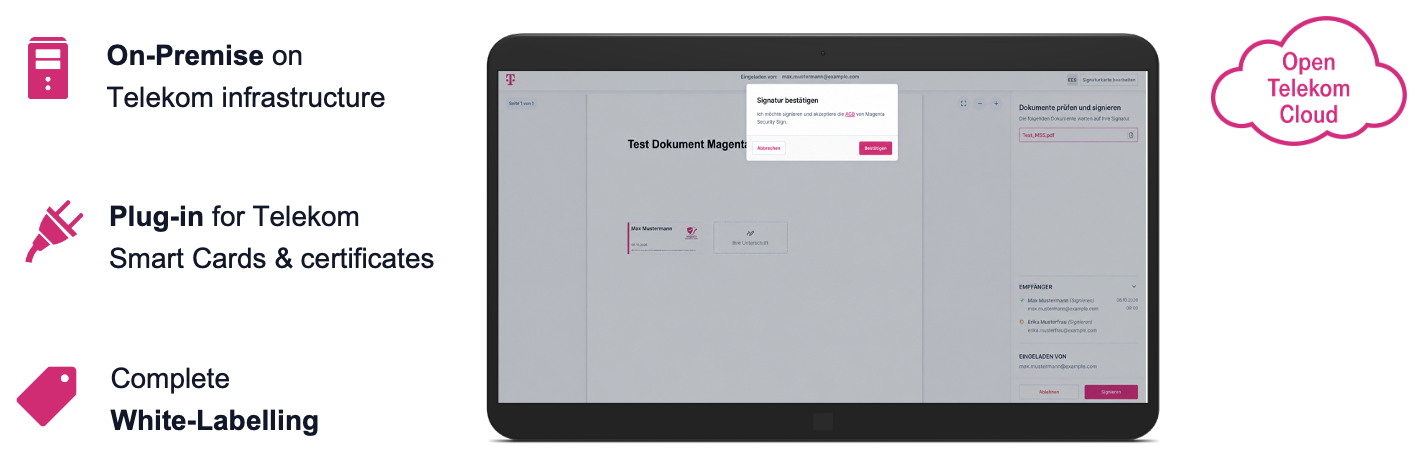
- A white-label solution that can be operated entirely on the Open Telekom Cloud
- Independent administration features for managing customers, domains, SSO and SCIM provisioning
- Plug-ins for existing Telekom signature cards and certificates
- Close, collaborative and agile cooperation on the product roadmap
Digital sovereignty is increasingly evolving from a selling point into a regulatory requirement. With its Tech Sovereignty Package, presented on 3 June 2026, the European Commission classifies digital dependency as a strategic risk. A core element is the proposed Cloud and AI Development Act (CADA), which is currently being discussed in the European Parliament and the Council. Among other things, it provides for an EU-wide framework for assessing the sovereignty of cloud and AI services in public procurement. Deutsche Telekom and Certifaction are already positioning themselves for this development with Magenta Security Sign, particularly in highly regulated sectors such as the public sector, healthcare and financial services, where sovereignty requirements are expected to have the greatest impact.
"We wanted a digitally sovereign European eSigning solution that meets our high standards of security and data protection, not just for ourselves but for our customers too. In Certifaction, we found exactly the right technology partner. With Magenta Security Sign, we can now offer both ourselves and our customers a secure solution for privacy-first eSignatures."
Aldo Izard Gosch, Lead Portfolio & Partner Strategy for Identity Security, Deutsche Telekom Security GmbH

The solution
In its search for the right technology partner, Deutsche Telekom Security chose Certifaction. The deciding factors were Certifaction’s consistent privacy-first approach to eSigning, the option of running the solution fully on-premises on Deutsche Telekom’s own Open Telekom Cloud, and its focus on digital sovereignty. Thanks to the white-label solution, Deutsche Telekom was able to integrate the technology fully into its own portfolio and offer it under its own brand.
A key difference from conventional eSigning solutions is the Zero Document Knowledge architecture. Sensitive documents remain under their owners’ control at all times: neither Deutsche Telekom as the operator nor any technology partner gains insight into their content at any point. For Deutsche Telekom, this privacy-first approach was a decisive building block on the path towards greater data protection and digital sovereignty.
In addition, the platform supports strict EU data residency and meets the highest standards of data protection and regulatory compliance.
Close collaboration between the Certifaction and Deutsche Telekom teams was just as crucial to the project’s success. In an agile project, the various Telekom signature cards and certificates were integrated into the modular eSigning solution, which was continuously adapted to Deutsche Telekom’s requirements.
The solution supports all signature types under the eIDAS Regulation, from the Simple Electronic Signature (SES) and the Advanced Electronic Signature (AES) to the Qualified Electronic Signature (QES).
The result
The collaboration with Certifaction resulted in Magenta Security Sign, Deutsche Telekom’s digitally sovereign eSigning solution for businesses and public-sector organisations.
Deutsche Telekom now offers its business customers a European privacy-first eSigning solution that combines data protection, ease of use and digital sovereignty.
Businesses benefit from a European alternative to DocuSign that is GDPR-compliant, eIDAS-compliant and consistently designed to protect sensitive documents. Thanks to Zero Document Knowledge, they stay in control of their documents at all times, without compromising on convenience or ease of use.
At the same time, Deutsche Telekom can run the solution entirely under its own brand and expand its portfolio with a secure white-label eSigning solution. Both Deutsche Telekom and its customers benefit from a future-proof electronic signature solution that puts European data protection standards and digital sovereignty firmly at its centre.
Would you like to offer your customers a privacy-first eSigning solution too?
Whether you are a business, a software provider or a sales partner, Certifaction lets you integrate a proven white-label solution into your portfolio quickly and seamlessly, and offer your customers a secure European alternative to DocuSign, built for digital sovereignty, data protection and trust.
Your path to the future
Join leading organizations
Contact us now to find out how we can help your company make your signing, certification and verification processes digital, intuitive and future-proof.
FAQs
Our answers to the most frequently asked questions
Are Certifaction's eSignatures legally valid?
Yes. Our eSignatures are legally valid and support all major global standards (incl. eIDAS, ZertES, UETA, ESIGN).
In addition, you can choose the signature type that suits you best: from the cost-effective simple eSignature to the qualified eSignature (QES).
What is the Zero Document Knowledge technology and what are the advantages?
Unlike most competing providers, Certifaction offers the option of signing documents without ever seeing their content. The documents are processed locally on the customer side and encrypted when using the web app.
In the case of API integration, a local gateway takes over the encryption. In the event of a hack, the file would therefore be encrypted and unreadable. We also ensure that the documents are stored on ISO 27001-certified servers in Switzerland or an EU country.
Is there a white-labeled version of Certifaction?
Yes, Certifaction offers a customised white label option for partners. This enables the seamless integration of own products such as eIDs and certificates. The white label solution gives partners complete control over the platform. As an integration partner, we help open up new revenue streams and maximise business potential by providing tailored solutions for individual needs.
How much integration work is involved?
The Certifaction WebApp can be used immediately in the browser. The eSignature solution can also be integrated quickly via an API connection. Alternatively, the solution can be used as a white label product with full personalisation. Depending on the requirements, this is ready within a few weeks.
Why should I choose Certification over an on-premises solution?
What makes Certification stand out from the competition?
Certifaction is characterised by its innovative technology and clear focus on partnerships. Our customers value us as a trustworthy European partner that not only offers close cooperation and the highest security standards, but also enables the integration of its own products through white label solutions. This opens up new business opportunities and additional revenue streams for our partners. Our solution offers:
- maximum security through Zero Document Knowledge
- innovative features such as the Digital Twin (making digitally signed documents verifiable even when printed out), bulk signing, Teamspaces (rooms with shared signature processes) and guest signatures without registration
- Signature requests in under a minute and smooth onboarding in just 15 minutes thanks to intuitive operation
- smooth identifications without app download within a very short time
- a recommendation score (NPS) of +90
Do you have any further questions?